DevOps consulting Services
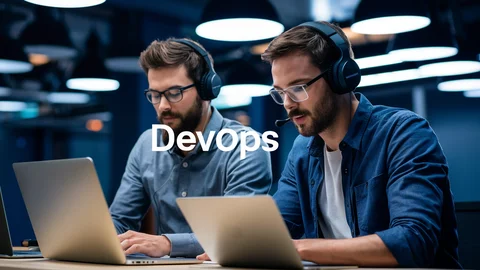
Porat Outsourcing provides custom DevOps services to improve your company’s tech performance. We work closely with your team to set up DevOps methods that fit your needs and goals. Our services cover the whole development cycle, from writing code to putting it to use.
We focus on making your tech processes run smoothly – less waiting time for new features and better software overall. Our experts know how to combine development and operations, creating a system that works well for everyone involved. By using our DevOps services, you can expect faster updates, fewer mistakes, and a more responsive tech team.
Contact us today for a free consultation.

Why choose DevOps consulting services for businesses?
Porat Outsourcing offers complete DevOps services to improve your business processes. Our experienced DevOps developers work to streamline your operations, increase efficiency, and promote innovation.
Why choose our DevOps services? Our DevOps model is built on four main parts: Development, Build and Test, Deployment, and Operation and Monitoring. This approach ensures smooth and efficient work flow from creating code to using it in production.
Key DevOps Services at Porat Outsourcing
We provide complete DevOps consulting services with eight main steps. Our approach combines development and operations efficiently. Throughout each step, our teams work closely together and communicate constantly to ensure speed, consistency, and high quality.

Initial Planning
We start with a team meeting to brainstorm ideas. This helps us match the work to the client’s goals. We use Agile methods to plan the work efficiently.

Choosing a Work Method
Our teams use Agile methods to improve work speed and quality. We work in small steps, which allows us to be more flexible.

Preparing the Development Path
Our DevOps developers use Git to manage code versions and combine work from multiple developers.

Checking the Code
We regularly combine the work of all developers. Our team uses automatic tests to make sure the code is good before combining it.

Distributing the Code
Our development teams release new software automatically and in stages, which increases efficiency and keeps quality high.

Managing Systems
At this stage, we manage all the infrastructure needed for the software to work, including planning, setup, and maintenance.
Monitoring Systems and Code
We constantly monitor how the software is performing. Our team gets automatic alerts about potential problems, which allows for quick fixes.
Continuous Improvement
At the end of each stage, we do a thorough evaluation and look for ways to improve. We also consider customer feedback to make the software better in future versions.
How DevOps Services Help Businesses
We provide DevOps services that improve teamwork between development and operations teams. In the past, these teams worked separately, which caused delays and problems. Our approach changes this by creating close teamwork, allowing for better communication and more efficient work. Our DevOps process works like this:
DevOps consultants help businesses develop better quality software, faster, and with fewer problems. This allows our clients to launch new products quicker, provide better service, and compete more effectively in the market.
Benefits of Using DevOps
Using DevOps changes how companies make software and has many advantages over old ways. Here are the main benefits of using DevOps:
Better communication: DevOps consultants help IT teams work together better, which reduces delays and problems.
Faster development: The process speeds up making software, helping companies earn more and compete better.
Better product: Getting quick feedback from users allows for fast and constant improvement of the software.
Higher quality: DevOps developers do more testing, leading to more reliable software with fewer issues.
Efficient processes: DevOps improves all steps of making software, from writing to releasing.
Less repeated work: Using automatic tools saves time on simple, repeated tasks. Happier developers: The team feels more responsible for the code, leading to better work.
Skill development: Team members learn new things and expand their abilities.
Contact us for a free consultation
-
 I am immensely grateful to Dor and the team for their outstanding effort in the recent product demo. Their resilience in the face of challenges and proactive problem-solving truly stood out. Even under tight schedules and high-pressure situations, they never lost their positive spirit. A special mention to Dor for his exemplary leadership. Every team member’s dedication and creativity were instrumental in our success. It’s a privilege to collaborate with such an exceptional group, and I am eager for what the future holds for our collaborations. Highly recommended!
 VP R&D, DeepKeep.ai
-
We’ve had the distinct pleasure of collaborating with Dor on multiple projects as our go-to fullstack developer. What sets Dor apart is his remarkable ability to simplify intricate processes, ensuring clear communication and effortless collaboration. Technically, Dor’s skills span the gamut—from frontend subtleties to backend intricacies. Simply put, Dor exemplifies the pinnacle of what one desires in a fullstack developer: unmatched technical knowledge, stellar communication, a team-oriented approach, and unwavering punctuality. We’re truly privileged to have partnered with him and eagerly anticipate our future endeavors together.
Y.S., Team Leader, Housetable

-
I am pleased to offer my unequivocal recommendation for the exceptional services provided by Porat. The company has demonstrated an unparalleled commitment, quick and efficient project execution, and professional work attitude throughout our collaboration, Porat exhibited a high degree of flexibility in adapting to our evolving requirements and consistently meeting deadlines.
Yaniv Brami Director Of Products Prisma Photonics

-
Thank you for a great and professionally DevOps services. The impact on the company is huge.
Michal B. VP R&D Epidutech